
The Order Within the Order
A Spiritual Compass in the Community of the Order of Saint George
The community of the Order of Saint George is held together not only by historical memory, symbols and ceremonies, but also by an internal order that shapes the relationship of its members to one another, to the community, to faith and to service.
“The Order within the Order” is the expression of this inner structure: not a legal regulation, nor a disciplinary code, but a spiritual and moral point of orientation. It summarizes those guiding principles that help us understand what conduct is worthy of the chivalric title, and how belonging to the community can become a living, responsible and authentic reality.
The Inner Order of the Chivalric Community
Belonging to the Order is not merely an honor, but a commitment. The chivalric title represents a form of dedication that carries responsibility toward the community, truth, loyalty and service.
The internal order of the Order arises from the recognition that the chivalric way of life is not an external ornament, but an inner disposition. The symbols worn, the historical traditions and the ceremonies are only authentic if accompanied by moral seriousness, discipline and self-reflection.
Loyalty to Truth
One of the fundamental pillars of the chivalric ideal is fidelity to truth. Members of the community are bound not only to one another, but also share a commitment to stand for truth, honor and integrity.
This loyalty is not merely a matter of principle but must be reflected in everyday conduct: in one’s word, in promises made, in responsibilities undertaken, in one’s attitude toward the affairs of the community, and in respect for others.
The motto of the Order reinforces this inner orientation:
„In veritate iustus sum huic fraternali societati.”
“In truth, I stand faithful to this brotherhood.”

Fraternal Community and Responsibility Toward One Another
The Order is a community, not merely a list of names. The relationships among its members must be shaped by mutual respect, trust and fraternal responsibility.
The strength of the community does not arise from individual ambition, but from a shared mission. Therefore, it is of particular importance that members do not appear as competing individuals, but as brethren who strengthen one another.
Conduct worthy of a chivalric community includes:
• respect for the dignity of others,
• willingness to cooperate,
• placing the interests of the community first,
• and the fair and measured handling of disagreements and differing views.
Discipline, Moderation and Self-Examination
The internal order of the chivalric community requires discipline.
This does not imply rigidity, but conscious self-control, inner balance and the willingness to engage in regular self-examination.
The chivalric path does not demand perfection but striving.
A member of the Order becomes authentic by being ready to face their own weaknesses, errors and limitations, and by embracing the path of inner growth.
Behind external symbols, there must always stand an inner integrity.
Without this, the chivalric form becomes empty; with it, it becomes a true force in building community.
The Primacy of Service
The history and present mission of the Order of Saint George both convey that the essence of the chivalric ideal is service.
A knight does not bear the title for himself, but to dedicate his strength to the benefit of the community, the preservation of cultural heritage, the strengthening of faith and the support of those in need.
This perspective is fully aligned with both the historical heritage and the contemporary mission of the Order: the chivalric ideal remains authentic only if it is actively lived in the present.
Service may take form in:
• the preservation of cultural and historical values
• scholarly and educational work
• community building
• the safeguarding of traditions
• and charitable activity
The Order of the Community and the Responsibility of Service
The internal order of the Order of Saint George is reflected not only in moral principles, but also in a clear structure of roles and responsibilities. Within the life of the community, every position and role serves the common mission: the unity, dignity, continuity and authentic functioning of the Order.
Titles and positions within the Order are not external marks of rank, but forms of service. Each role represents an area of responsibility and expresses the mission undertaken by the individual for the benefit of the community.
The Place and Responsibility of the Knight
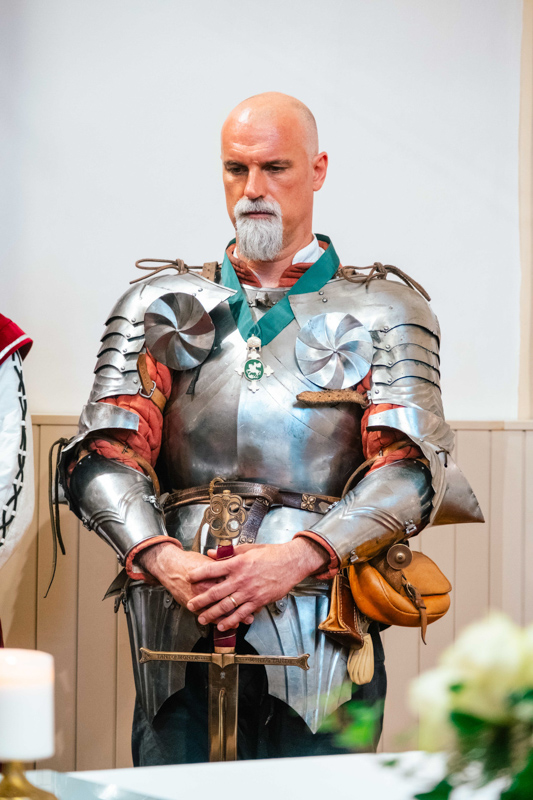
The fundamental unit of the Order is the knight, who, through his oath, becomes a member of the community and commits himself to following the ideals of faith, loyalty, truth and service in his life and work.
The chivalric title is both an honor and an obligation.
The community rightly expects that a knight:
• is present at important events of the Order
• actively participates in the work of the community
• strengthens the reputation of the Order through his conduct
• and strives to live according to chivalric virtues in his personal life
The knight is therefore not a passive member, but an active participant.
The strength of the community lies not in the number of titles, but in active, responsible and mutually supportive members.
This is in harmony with the principle that becoming a knight is not a single moment, but an ongoing commitment.
The path from candidacy through investiture to the fulfillment of the chivalric vocation is a continuous process.
The Place of the Postulant and the Squire
The path toward the Order does not begin in a single moment. The presence of postulants and squires reflects that the chivalric community is open to those who wish to understand its spirit and, in time, to embrace its values.
The period of candidacy is a time of preparation, observation and inner alignment. It is not merely an administrative transition, but a moral and communal test. The presence of squires and young members expresses that the transmission of chivalric heritage takes place from generation to generation.
The Responsibility of the Grand Prior
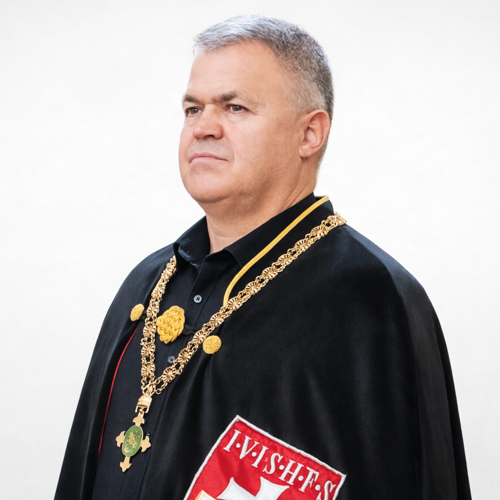
The responsibility of the Grand Prior extends over a broader community. He is entrusted with guiding, coordinating and representing not a single priory, but a larger organizational unit of the Order.
The Grand Prior is one of the primary guardians of continuity, unity and the chivalric spirit. His role is especially significant where multiple communities or larger regions must be brought together.
His task is to maintain a living connection between local initiatives and the overall spirit of the Order, ensuring that while communities preserve their distinct character, they remain united in a shared mission.
The Service of the Prior
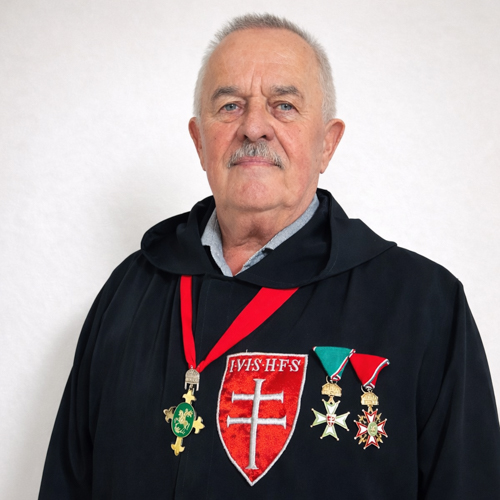
The Prior is the leader and unifying figure of the local community. His role is not limited to organization, but carries both communal and spiritual responsibility. It is his task to coordinate the life of the priory, represent it, and support members in living out the shared mission in unity and discipline.
The service of the Prior includes:
• coordinating the life of the local community,
• ensuring connection to Order-wide events and celebrations,
• fostering cooperation among members,
• and authentically representing the spirit of the Order within the priory.
The Prior does not rule over the community, but serves its order, unity and dignity.
The Meaning of Positions: Service, Not Privilege
The various positions within the Order—whether that of Prior, Grand Prior or other roles—fulfill their true purpose only when they are understood not as privileges, but as responsible forms of service.
A member is not worthy because of the title he holds, but because of the way he carries out the responsibilities entrusted to him—with loyalty, moderation and a commitment to the good of the community.
The essence of a position lies not in entitlement, but in accountability, example and the willingness to bear the burdens of the community.
Order and Unity
The structure of roles and responsibilities exists not to create distance, but to ensure clarity and transparency. The internal order of the community remains alive and healthy when each member understands his place, responsibility and task. The knight, the Prior, the Grand Prior and all others in service are part of the same mission. The unity of the Order arises from the fact that these roles do not divide, but complement one another in serving the same ideal.
Within the community of the Order of Saint George, the order of responsibility is the order of service. Positions remain authentic only when supported by humility, example, fraternal spirit and a genuine will to serve the common good. Thus, the internal order of the Order is both a moral and communal reality: guidance for the knight, responsibility for the Prior, and a unifying mission for the entire Order.
Not an Ideology, but a Spiritual Orientation
The spirit of the Order is not built upon daily political or ideological affiliations. Its identity rests on deeper foundations: Christian values, historical awareness, a sense of the sacred, respect for Hungarian and European heritage, and a commitment to the community.
This does not mean that members cannot think differently on social issues. It means that the unity of the Order is sustained not by temporary trends, but by enduring spiritual foundations.
The Unity of the Order as a Guarantee of the Future
The heritage of more than seven centuries can remain alive only if members not only remember it, but carry it in their lives. The unity, dignity and authenticity of the Order are not self-evident; each generation must reaffirm them.
“The Order within the Order” is therefore not a closed set of statements, but a reminder: it calls us to live the chivalric ideal not only as historical heritage, but as a daily moral and communal responsibility.
Belonging to the Order of Saint George means being part of a community with a great past, yet still living today—one that calls upon its members to uphold truth, loyalty, service and fraternal responsibility.
The external forms of the Order—symbols, the kappa, ceremonies and traditions—gain their true meaning only when supported by the internal order: the discipline of the chivalric spirit, fidelity to the community, and the readiness to represent our values authentically in the present.
Further information about the Order
Contact us
Feel free to contact us with your questions or collaboration inquiries.
You can also follow our activities on our social media platforms.